| Desktop Environments |
| |
| K Desktop Environment |
| |
| What is KDE? |
| |
| KDE is a desktop environment. In other words, KDE is a collection of programs, technologies and documentation that attempt to make life easier for computer users. KDE is targeted at UNIX® workstations. It features network transparency and a contemporary work philosophy. |
| |
| The creators of the K Desktop Environment are a world-wide group of software engineers. This group's major goal in free software development is to provide high quality software that empowers the user with easy control of his computer's resources. |
| |
| KDE seeks to fill the need for an easy to use desktop for UNIX® workstations, similar to the desktop environments found under Mac® OS or Windows® 95/NT. KDE meets the requirement of users for an easy to use work environment. Tools used to reach this end are: enhanced inter-application communication, component reuse, generalized drag and drop, uniform look and feel and many more. Thus, KDE offers much more than the traditional UNIX® window managers. |
| |
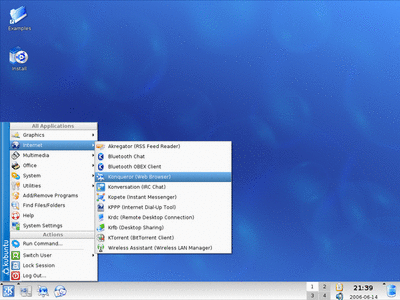
| The K Desktop Environment is made of following components: |
| |
|
| |
| Desktop Environment |
| |
| In combination with a free implementation of UNIX®, KDE provides to the world an open and completely free desktop computing platform either at home or at work.
This platform is available to anyone free of charge including its source code for anyone to modify. |
| |
| While there will always be room for improvement we believe we have now delivered a viable alternative to some of the more commonly found and commercial operating systems/desktops combinations available today. It is our hope that the combination of UNIX® and KDE will finally bring the same open, reliable, stable, and monopoly free computing to the average computer user that scientists and computing professionals world-wide have enjoyed for years. |
| |
| Application Development Framework |
| |
| KDE focuses on the user's needs, but it's obvious that this focus is more easily achieved by also giving developers the best tools. KDE code contains, and comes with, some of the best development technologies of the modern computing age. |
| |
| Authoring applications under UNIX®/X11 used to be an extremely tedious and labor intensive process. KDE recognizes the fact that a computing platform is only as good as the number of first class applications available to the users of that particular platform. |
| |
| KDE defines new technologies in DCOP and KParts, created to offer a component document model and technology. Together with the complete KDE libraries programming interface, DCOP/KParts are set in direct competition with other similar technologies like Microsoft® MFC/COM/ActiveX technologies. The excellent quality and the high level of refinement of KDE's application programming interface (API) enables developers to focus on original and interesting issues and avoid reinventing the wheel. |
| |
| KDE Application Suite |
| |
| In its current form, KDE provides, apart from the essential desktop component applications, a suite of powerful office programs known to the world by the name KOffice. |
| |
| KOffice is based on the KDE DCOP/KParts technologies. It currently contains: a word processor with desktop publishing capabilities (KWord), a spreadsheet application (KSpread) and accompanying charting program (KChart), a presentation program (KPresenter) and a vector drawing program (Kontour). |
| |
| Tying things together is the KOffice Workspace, an integrated shell to ease the use of the KOffice components in conjunction with each other. Additional components include an email client, a news reader, and a powerful PIM (Personal Information Manager - an organizer). |
| |
| |
| |
| |
| |


