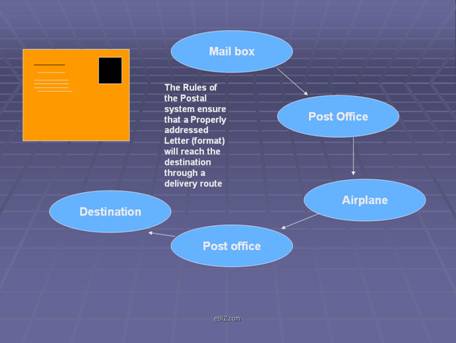
A comparison can be made to the rules that govern how letters are handled by the post office:
Some of the protocols used on the Internet are:
 |
 |
 |
| Finctionality of Internet | |||
| Protocol | |||
| A protocol is a standard set of rules that governs how computers communicate with each other. Protocols describe both the format that a message must take and the way in which messages are exchanged between computers. | |||
| Different types of computers are able to communicate with each other - in spite of their differences - when they agree to use a protocol that offers a standard format and method for communication. Some of the protocols used on the Internet are TCP/IP, SMTP, FTP, HTTP, and NNTP. | |||
| A protocol is a standard set of rules that determines how computers communicate with each other across networks. A network is two or more computers that are physically connected to each other and able to share information. | |||
| When computers communicate with one another, they exchange a series of messages. To understand and act on these messages, computers must agree on what a message means. | |||
| Examples of messages include establishing a connection to a remote machine; sending or receiving e-mail; and transferring files and data. | |||
| A protocol describes: | |||
| • the format that a message must take, and | |||
| • the way in which computers must exchange a message | |||
| within the context of a particular activity, such as sending messages across networks, exchanging e-mail, establishing remote connections, or transferring files. | |||
| Think of an electronic mail message. Both the format of the electronic mail message and the way that it is transmitted across the network are described and governed by a protocol. | |||
| Protocols ensure that electronic mail messages are correctly formatted and transmitted from the originating computer to the destination computer. A comparison can be made to the rules that govern how letters are handled by the post office: |
|||
|
|||
| There are different protocols for different types of network services. For example, the Internet is based on the TCP/IP suite, or family, of protocols. Some of the protocols used on the Internet are: |
|||
| • Simple Mail Transfer Protocol (SMTP) - to send and receive electronic mail | |||
| File Transfer Protocol (FTP) - to transfer files between computers | |||
| Hypertext Transfer Protocol (HTTP) - to transmit information on the World Wide Web | |||
| Network News Transfer Protocol (NNTP) - to transmit network news | |||
| Protocols enable different types of computers (Macintosh, PCs, UNIX, VMS, etc.) to communicate in spite of their differences. This is because they describe a standard format and method for communicating. | |||
| A very simple comparison can be made to Morse Code: | |||
| • People using Morse Code agree that a given combination of dots and dashes will always have the same meaning. | |||
| Someone who speaks only Russian and someone who speaks only Greek can exchange messages using Morse Code because they agree on the format and method for exchanging messages. | |||
|
|||