modem speed
level of service
 |
 |
 |
| Finctionality of Internet | |||
| ISP | |||
| Internet Service Provider? | |||
| An Internet Service Provider (ISP) is a company that provides access to the Internet. Their customers can be businesses, individuals or organizations. The advent of ISPs has made connecting to the Internet an affordable and convenient option for many people. | |||
| ISPs are also sometimes referred to as Internet Access Providers. | |||
| ISPsoffer different types of connections. Two common connectivity options are: | |||
| Dial-up shell accounts | |||
| SLIP/PPP (Serial Line Internet Protocol or Point-to-Point Protocol) | |||
| Dial-up shell accounts | |||
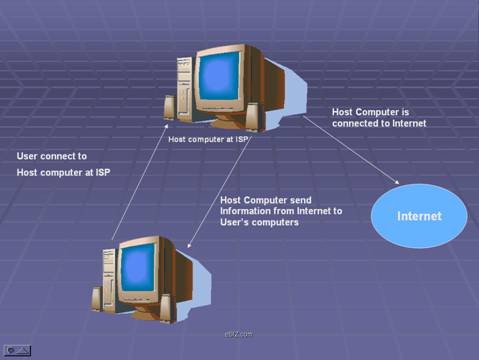
| The user connects with a modem and phone line to a host machine at the ISP. The host machine is connected to the Internet; therefore, the user can access the Internet via the host machine. | |||
| All software needed for Internet access, such as TCP/IP (Transmission Control Protocol/Internet Protocol) is on the host machine, not the user's computer. | |||
| Also, the user must use the client programs that reside on the host machine. For example, if the host uses a Lynx web browser and command line ftp, then the user must also use these tools. | |||
|
|||
| Dial-up accounts provide access but cannot support graphical interfaces, as these must be run on the user's desktop computer. | |||
| SLIP/PPP | |||
| In this option, the user also uses a modem to connect to a remote computer (called a SLIP server) at the ISP. However, in a SLIP/PPP account, the user's computer has both SLIP/PPP and TCP/IP software installed directly on it. | |||
| This allows the user to choose whatever client programs (web browsers, ftp client, telnet client, etc.) he or she desires. | |||
| SLIP/PPP cont'd | |||
| Once a connection has been made to a SLIP server at the ISP, the SLIP/PPP software on the user's computer requests a SLIP/PPP connection. Then, the ISP assigns an IP (Internet Protocol) address to the user's computer. | |||
| Often, an ISP has a block of IP addresses that they assign to user's "on-the-fly" at the time the connection is made; a user may not always get the same IP address. | |||
| At this point, the TCP/IP software on the user's computer "takes over" and manages the flow of data between the Internet and the user's computer. | |||
| In addition to providing access to the Internet, ISPs usually offer additional services as well. These services can include: | |||
| • Web hosting - An individual or organization can place their web pages on a web server located at the ISP. These web pages can then be accessed by Internet users. | |||
| Domain Name Service - Provides domain name servers, which are computers dedicated to translating a customer's domain name into the actual numeric IP (Internet Protocol) address of the customer's computer. Domain name service is integral to the proper functioning of the Internet. | |||
| Proprietary Online Services - Such as the custom services offered by America Online, Inc. or CompuServe. These special options are available only to their subscribers. | |||
| ISPs charge a fee for the service of providing Internet access. Charges vary from region to region and can depend on variables such as: | |||
| • type of connection modem speed level of service |
|||
| Some ISPs charge for each hour that a user is connected to the ISP. Other service providers allow unlimited connection time once the user has paid a flat fee - either by the month or by the year. | |||
| There are many sources of information about Internet Service Providers via the World Wide Web. | |||
| Two sources are: | |||
| In Summary: | |||
| An Internet Service Provider is a company that provides Internet access. Customers can be businesses, individuals and organizations. Two common types of Internet access are dial-up shell accounts and SLIP/PPP accounts. | |||
| In a shell account, the user connects to a host computer at the ISP and can then access the Internet through the host computer. All necessary software is on the host machine, not the user's machine. | |||
| In a SLIP/PPP account, the user has all necessary software installed on his or her computer and connects directly to the Internet through the ISP. | |||
| Additional services that can be offered by an ISP include web hosting, domain name service and proprietary online services. Fees charged by ISPs vary from region to region and depend on a number of variables such as type of connection and level of service. | |||
|
|||