Unique
Global
Standardized
.No two machines can have the same IP number. .
IP addresses are also global and standardized. .
All machines connected to the Internet agree to use the same scheme for establishing an address.
 |
 |
 |
| Finctionality of Internet | |||
| IP Addresses | |||
| An IP address is a unique, numeric identifier used to specify a particular host on a particular network, and is part of a global, standardized scheme for identifying machines that are connected to the Internet. | |||
| IP addresses consist of four numbers between 0 and 255, separated by periods, which represent both the network and the host machine. | |||
| The InterNIC, under the authority of the Internet Assigned Numbers Authority (IANA), allocates the network portions of IP addresses to Internet Service Providers (ISPs); ISPs are responsible for assigning the host portion of the IP address to machines within their local networks. | |||
| A way to identify machines on the Internet | |||
| A number Unique Global Standardized |
|||
| If you want to connect to another computer, transfer files to or from another computer, or send an e-mail message, you first need to know where the other computer is - you need the computer's "address." | |||
| An IP (Internet Protocol) address is an identifier for a particular machine on a particular network; it is part of a scheme to identify computers on the Internet. | |||
| IP addresses are also referred to as IP numbers and Internet addresses An IP address consists of four sections separated by periods. Each section contains a number ranging from 0 to 255. | |||
| Example = 198.41.0.52 | |||
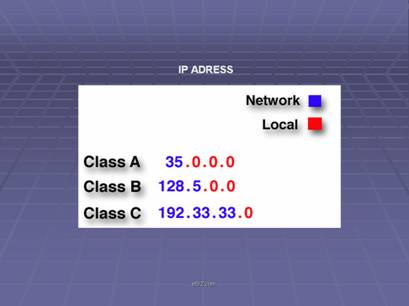
| Which sections of the IP address represent the network and which sections represent the machine will depend on what "class" of IP address is assigned to a network. There are 5 classes of IP addresses: Class A, Class B, Class C, Class D, and Class E. | |||
| Classes correspond either to the size of the network (the number of hosts that the network can support) or are reserved for specific purposes, such as multicasting and experimentation. | |||
| The diagram below compares Class A, Class B and Class C IP addresses. The blue numbers represent the network and the red numbers represent hosts on the network. Therefore, a Class A network can support many more hosts than a Class C network. | |||
|
|||
| IP addresses are unique.
.No two machines can have the same IP number. . IP addresses are also global and standardized. . All machines connected to the Internet agree to use the same scheme for establishing an address. |
|||
|
|||