| Finctionality of Internet |
| |
| Internet Addressing |
| |
| Internet addressing is used to identify people, computers, and Internet resources. |
| |
| Using the Internet requires an understanding of different addressing schemes. People are identified with electronic mail addresses. Computers are identified with IP addresses and domain names. Resources and files available through the World Wide Web are identified using URLs. |
| |
• A way to locate people, computers, and Internet resources
IP (Internet Protocol) addresses and domain names
Electronic mail addresses
URLs |
| |
| In general, Internet addressing is a systematic way to identify people, computers and Internet resources. On the Internet, the term "address" is used loosely. Address can mean many different things from an electronic mail address to a URL. |
| |
| IP Address |
| |
An IP address is a unique number that identifies computers on the Internet; every computer directly connected to the Internet has one.
An IP address consists of four numbers separated by periods. Each number must be between 0 and 255.
An example is: 204.81.205.32 |
| |
| Domain Name |
| |
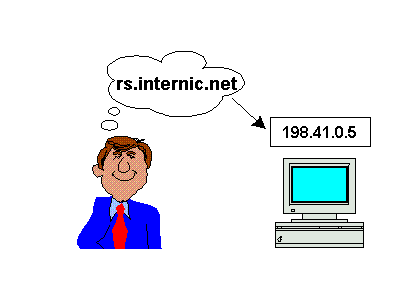
| Most computers on the Internet have a unique domain name.
Special computers, called domain name servers, look up the domain name and match it to the corresponding IP address so that data can be properly routed to its destination on the Internet. |
| |
| An example domain name is: healthyway.com
Domain names are easier for most people to relate to than a numeric IP address. |
| |
| |
 |
| |
| Electronic Mail Address |
| |
| An Internet electronic mail, or e-mail, address is used to identify a person (or persons) and a computer for purposes of exchanging electronic mail messages. |
| |
| An example Internet e-mail address is: janedoe@xyz.edu |
| |
| Internet e-mail addresses are read from left to right: |
| |
| • "janedoe" is the name of the person receiving or sending the message; this is referred to as the username. |
| |
| • "xyz" is part of the domain name of the organization |
| |
| • "edu" is also part of the domain name and indicates that "xyz" is an educational institution. |
| |
| Electronic Mail Address |
| |
Other networks may use different electronic mail addressing schemes within their own networks. To be used in Internet e-mail, these addresses often need to be modified.
For example, within CompuServe an e-mail address consists only of two numbers separated by a comma: 36547,891. |
| |
| To convert this to an address that can be used on the Internet, the comma is changed to a period and the number serves as the username. |
| |
| The domain name is compuserve.com, so the Internet address would be: 36547.891@compuserve.com |
| |
| URLs |
| |
| URL stands for Uniform Resource Locator. URLs are used to identify specific sites and files available on the World Wide Web.
The structure of a URL is: protocol://server.subdomain.top-level-domain/directory/filename |
| |
Not all URLs will have the directory and filename.
Two examples: |
| |
• http://www.healthyway.com/exercise/mtbike.html
gopher://gopher.state.edu/ |
| |
| URLs |
| |
Similar to an e-mail address, a URL is read like a sentence.
|
| For example the URL
http://www.healthyway.com |
| |
| is read as "http colon forward slash forward slash www dot healthyway dot com". |
| |
| |
|
| |
| |


