| Components of Internet |
| |
| WWW |
| |
| The World Wide Web is a system of Internet servers that supports hypertext to access several Internet protocols on a single interface. The World Wide Web is often abbreviated as the Web or WWW.The World Wide Web was developed in 1989 by Tim Berners-Lee of the European Particle Physics Lab (CERN) in Switzerland. |
 |
|
| |
| The initial purpose of the Web was to use networked hypertext to facilitate communication among its members, who were located in several countries. |
| |
| Word was soon spread beyond CERN, and a rapid growth in the number of both developers and users ensued. In addition to hypertext, the Web began to incorporate graphics, video, and sound. |
| |
| The use of the Web has reached global proportions and has become a defining aspect of human culture in an amazingly short period of time. |
| |
Almost every protocol type available on the Internet is accessible on the Web. Internet protocols are sets of rules that allow for intermachine communication on the Internet.
The following is a sample of major protocols accessible on the Web: |
| |
| E-mail (Simple Mail Transport Protocol or SMTP) Distributes electronic messages and files to one or more electronic mailboxes |
| |
| Telnet (Telnet Protocol) Facilitates login to a computer host to execute commands |
| |
| FTP (File Transfer Protocol) Transfers text or binary files between an FTP server and client |
| |
| Usenet (Network News Transfer Protocol or NNTP) Distributes Usenet news articles derived from topical discussions on newsgroups |
| |
| HTTP (HyperText Transfer Protocol) Transmits hyptertext over networks. This is the protocol of the Web. |
| |
| Many other protocols are available on the Web. To name just one example, the Voice over Internet Protocol (VoIP) allows users to place a telephone call over the Web. |
| |
| The World Wide Web provides a single interface for accessing all these protocols. This creates a convenient and user-friendly environment. Once upon a time, it was necessary to be conversant in these protocols within separate, command-level environments. |
| |
| The Web gathers these protocols together into a single system. Because of this feature, and because of the Web's ability to work with multimedia and advanced programming languages, the Web is by far the most popular component of the Internet. |
| |
| • A way to provide and access information resources on the Internet |
| |
Based on hypertext and HTTP (Hypertext Transfer Protocol)
Non-linear
Multimedia
Flexible |
| |
| The World Wide Web, also referred to as the WWW and "the Web," is the universe of information available via hypertext transfer protocol (HTTP). |
| |
| The World Wide Web and HTTP: |
| |
| • Allow you to create "links" from one piece of information to another;
can incorporate references to sounds, graphics, and movies, etc.;
"understand" other Internet protocols, such as ftp, gopher, and telnet. |
| |
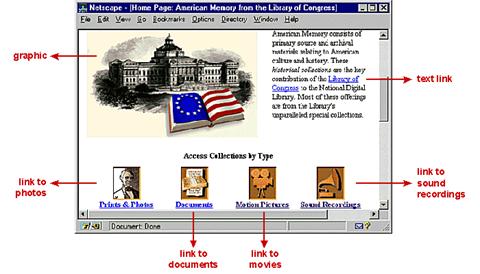
| • The Web presents information as a series of "documents," often referred to as web pages, that are prepared using the Hypertext Markup Language (HTML). |
| |
| Using HTML, the document's author can specially code sections of the document to "point" to other information resources. These specially coded sections are referred to as hypertext links. |
| |
| Users viewing the webpage can select the hypertext link and retrieve or connect to the information resource that the link points to. |
| |
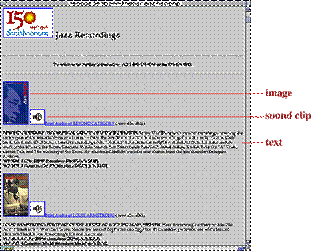
| Hypertext "links" can lead to other documents, sounds, images, databases (like library catalogs), e-mail addresses, etc. This sample web page is from the Smithsonian: |
| |
 |
| |
| Because it can incorporate graphics and "understands" other Internet protocols, the web can provide an easy-to-use interface for resources available via these protocols. |
| |
 |
| |
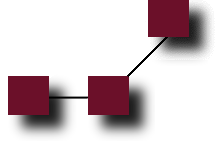
| • The World Wide Web is non-linear. There is no top, there is no bottom. Non-linear means you do not have to follow a hierarchical path to information resources. |
| |
| You can jump from one link (resource) to another: |
| |
|
 |
| |
| You can go directly to a resource if you know the Uniform Resource Locator (URL) (its address): |
| |
|
|
| |
| You can even jump to specific parts of a document. |
| |
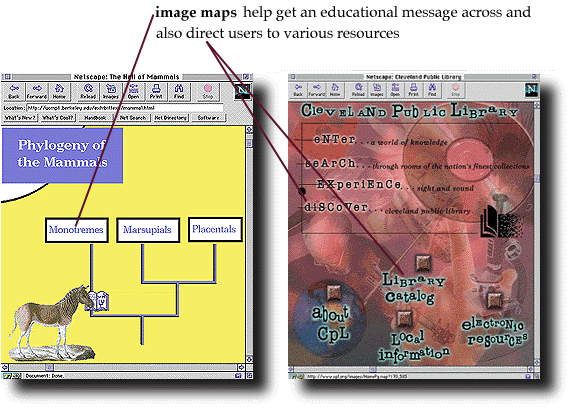
| Because the Web is not hierarchical and can handle graphics, it offers a great deal of flexibility in the way information resources can be organized, presented, and described. |
| |
 |
| |
| The World Wide Web is a system, based on hypertext and HTTP, for providing, organizing, and accessing a wide variety of resources (text, images, sound) that are available via the Internet. |
| |
|
The advantages of the Web are its flexibility in organizing and presenting information, its non-hierarchical easy-to-navigate structure, its ability to handle and "understand" many different file formats and Internet protocols, and its overall ease of use |
| |
| |
|
| |


