| Elements of C++ Language |
| |
| Pointers |
| |
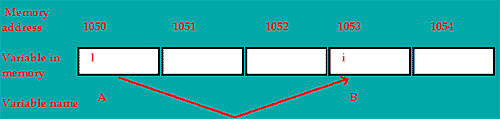
| A pointer is a variable that holds a memory address. This address is usually the location the location of another variable in memory. |
| |
| If one variable contains the address of another variable, is said to point to the second. |
| |
 |
| |
| References |
| |
| A reference is an alternative name for an object. A reference variable provides an alias for a previously defined variable. |
| |
| C++ introduces a new data type called reference. You can think of them as if they were "aliases'' to "real'' variables or objects. |
| |
| As an alias cannot exist without its corresponding real part, you cannot define single references. The ampersand (&) is used to define a reference. |
| |
| For example: |
| |
| int ix; /* ix is "real" variable */ |
| int ℞ = ix; /* rx is "alias" for ix */ |
| |
| ix = 1; /* also rx == 1 */ |
| rx = 2; /* also ix == 2 */ |
| |
| References can be used as function arguments and return values. |
| |
| This allows to pass parameters as reference or to return a "handle'' to a calculated variable or object. |
| |
| |
|
| |
| |


