| Introduction to Windows XP |
| |
| Introduction |
| |
| The operating system (OS) is the most important program that runs on a computer. It performs basic tasks like recognizing input from the keyboard, sending images to the display, keeping track of files, and controlling peripheral devices such as disk drives and printers. |
 |
| Windows XP is the latest version of Windows. Though there are many new features in Windows XP, the most striking of them is the changed interface. The new interface includes a changed Start Menu which lets you work in Windows much easily. |
|
| The Start Menu does this with the help of Personalized Menus, where the programs that you use frequently are listed on top and the programs that are only occasionally used are hidden. |
| |
| |
| The new version of Windows represents an important change from the previous version. Since Windows95 was released the successive versions had only been an evolution from the original, nevertheless on this occasion a more important change was produced because the very center or Kernel of the operating system has been changed. Although it may seem to the user that no radical changes were made, it could be said that WindowsXP is not just another version of Windows but practically a whole new system |
| |
 |
| |
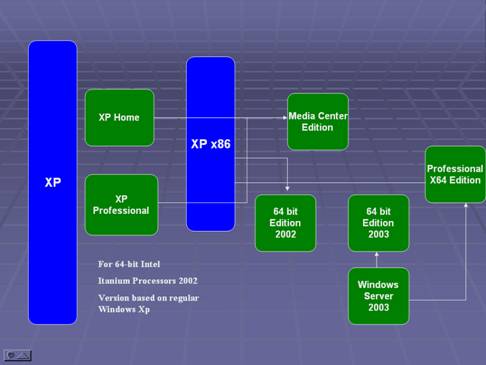
| The most common editions of the operating system are Windows XP Home Edition, which is targeted at home users, and Windows XP Professional, which has additional features such as support for Windows server Domain and dual process, and is targeted at power users and business clients. Window XP Media Center Edition has additional multimedia features enhancing the ability to record and watch TV shows, watch DVDs, and listen to music. Windows XP Tablet PC Edition is designed to run the ink-aware Tablet PC platform. Two separate 64 bit versions of Windows XP were also released, Windows XP 64-bit Edition for IA-64(Itanium) processors and Windows XP professional x64 Edition for x84-64 processors. |
| |
| Until now Microsoft had two different operating systems, Windows 98 for personal or domestic use and Windows NT/2000 for the business and professional environment. With WindowsXP a convergence among both versions is produced; the center of the operating system Windows 2000 was divided to create WindowsXP, and some adjustments were done to differentiate WindowsXP Home Edition and WindowsXP Professional. |
| |
| |
|
| |
| |

