| Physical Characteristics of a Network |
| |
| Transmission Techniques |
| |
| Baseband transmission - |
| |
| To transmit encoded signals over cable, we mainly use two techniques such as Baseband transmission and broadband transmission. |
| |
| Baseband systems use digital signaling over a single frequency. Signals flow in the form of discrete pulses of electricity or light. |
| |
| As the signal propagates along the cable, it gradually decreases in strength and can become distorted. |
| |
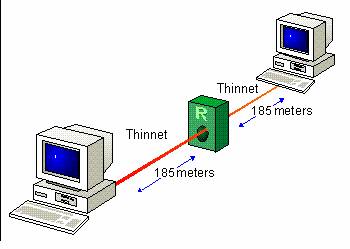
| To overcome this problem Baseband system sometime s use repeaters. |
| |
| Repeaters receive an incoming signal and retransmit it at its original strength and definition. Thereby increasing the practical length of a cable. |
| |
 |
| |
| Broadband Transmission - |
| |
| Broadband systems use analog signaling and a range of frequencies. |
| |
| With analog transmission the signals employed are continuous and non discrete. |
| |
| Signals travel across the physical medium in the form of electromagnetic or optical waves. |
| |
| To regenerate analog signals broadband systems use amplifiers. |
| |
| Because the signal flows in broadband transmission is unidirectional, there must be two paths for data flow. |
| |
| The two common ways to accomplish this are |
| |
| i) Mid-split broadband configuration divided the bandwidth into two channels; one is used for transmitting signals, the other is for receiving. |
| |
| ii) In dual cable broadband configuration, each device is attached to two cables. One is used to send and the other to receive. |
| |
| |
| |
| |
| |


