| e-Mail |
| |
| Introduction to E-mail |
| |
| Electronic mail, or e-mail, is probably the most popular and widely used Internet function. E-mail, email, or just mail, is a fast and efficient way to communicate with friends or colleagues. You can communicate with one person at a time or thousands; you can receive and send files and other information. You can even subscribe to electronic journals and newsletters. |
 |
|
| |
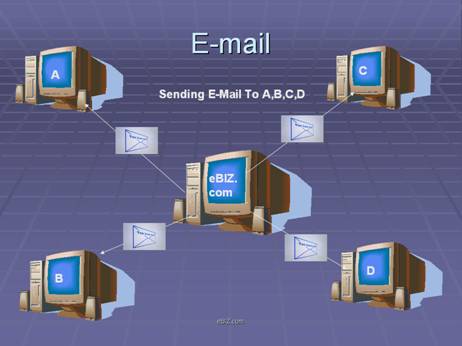
| You can send an e-mail message to a person in the same building or on the other side of the world. |
| |
| It's very similar to our traditional mail system with post boxes, post offices, envelopes and addresses. The difference is that instead of Australia Post delivering your messages around the globe for you, messages are sent electronically to other computer users via the computer network (the internet) taking a fraction of the time to get there AND, you don't have to walk to the letter box! |
| |
| Just as you can send attachments with your letters in the normal post (snail mail) you can also send computer documents, graphics, software or anything else that can be turned into a digital form attached to an email message. |
| |
 |
| |
| An e-mail address identifies a person and the computer for purposes of exchanging electronic mail messages. The basic structure of an e-mail address is: |
| |
| • username@host.subdomain.second-level-domain.first-level-domain |
| |
| The Internet mail system works because of SMTP, Simple Mail Transfer Protocol. SMTP is part of the TCP/IP suite of protocols.
SMTP is a protocol, or set of rules that enables electronic mail to move smoothly through the Internet. Because of SMTP, a UNIX machine can send mail to a PC or Macintosh computer and vice versa. |
| |
| Electronic mail works on the client/server principle. A client program enables the user to interact with a server in order to access information and services on the server computer.
To read and send mail, users need to access the computer where their mail resides (the server). |
| |
| The client application is the interface which lets a user read, reply to, forward, compose and send new messages.
Some examples of e-mail client programs are Qualcomm Eudora, pine, elm and Lotus cc: Mail.
|
| |
| An electronic mail message is not limited to text. Other types of files can be added to mail messages as attachments. Attachments can be binary files such as a word processed document, a spreadsheet or a graphic image. |
| |
| A standard called MIME, Multipurpose Internet Mail Extensions, allows for non-text files to be encoded on the sending computer and decoded on the receiving computer. |
| |
| Electronic mail is a system that allows users to send and receive messages and data through the Internet. SMTP is the protocol that ensures this system of sending and receiving information works smoothly. |
| |
| A client program is used to read mail, reply to mail and send new messages. Messages can contain text as well as other file types which are encoded and decoded by MIME. |
| |
| |
|
| |
| |


