| Finctionality of Internet |
| |
| TCP/IP |
| |
| TCP/IP is a communications protocol used to transfer digital data around the internet. TCP and IP were developed by a Department of Defense (DOD) research project to connect different networks designed by different vendors into a network of networks (the "Internet"). TCP/IP is often referred to as the 'internet protocol'. |
| |
| As with all communications protocols, TCP/IP is composed of layers: |
| |
| IP - is responsible for moving packet of data from node to node. IP forwards each packet based on a four byte destination address (the IP number). The Internet authorities assign ranges of numbers to different organizations. |
| |
| The organizations assign groups of their numbers to departments. IP operates on gateway machines that move data from department to organization to region and then around the world. |
| |
| TCP - is responsible for verifying the correct delivery of data from client to server. Data can be lost in the intermediate network. TCP adds support to detect errors or lost data and to trigger retransmission until the data is correctly and completely received. |
| |
| Sockets - is a name given to the package of subroutines that provide access to TCP/IP on most systems. |
| |
| TCP/IP is a suite, or family, of protocols that govern the way data is transmitted across networks. |
| |
| TCP/IP protocols work together to break the data into small pieces that can be efficiently handled by the network, communicate the destination of the data to the network, verify the receipt of the data on the other end of the transmission, and reconstruct the data in its original form. |
| |
| TCP/IP stands for Transmission Control Protocol/Internet Protocol. TCP/IP is actually a collection of protocols, or rules, that govern the way data travels from one machine to another across networks. |
| |
| The Internet is based on TCP/IP.
TCP/IP has two major components: TCP and IP. |
| |
| • IP: |
| |
| Envelopes and addresses the data
enables the network to read the envelope and forward the data to its destination
defines how much data can fit in a single "envelope" (a packet) |
| |
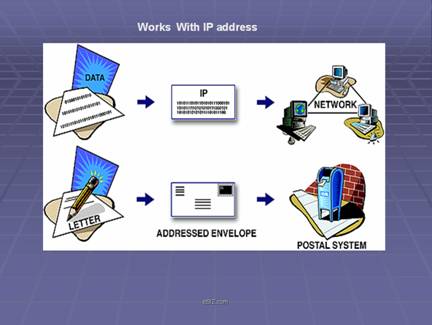
| The relationship between data, IP, and networks is often compared to the relationship between a letter, its addressed envelope, and the postal system. |
| |
 |
| |
| TCP |
| |
| TCP/IP can be compared to moving across country.
You pack your house in boxes and put your new address on them.
The moving company picks them up, makes a list of the boxes, and ships them across country along the most efficient route - this may mean putting your dishes and your bedroom furniture on different trucks. |
| |
| Your belongings arrive at your new address. You consult your list to make sure that everything you shipped has arrived (in good shape), then you unpack your boxes and "reassemble" your house. |
| |
| |
|
| |
| |


