| Finctionality of Internet |
| |
| Clint Server Architecture |
| |
| Client/server computing |
| |
| Client/server computing is a common networking model which enables many users to access information in an efficient manner. Generally, the user's computer is called the client and the machine that contains the information being accessed is called the server. |
| |
| Client/server computing is a phrase used to describe a model for computer networking.
This model offers an efficient way to provide information and services to many users.
A network connection is only made when information needs to be accessed by a user. This lack of a continuous network connection provides network efficiency. |
| |
| In client/server computing, processes are divided between the client and the server. This relationship is based on a series of requests and responses. |
| |
| Client: Requests services or information from another computer (the server computer). |
| |
| Server: Responds to the client's request by sending the results of the request back to the client computer. |
| |
|
 |
| |
| In a client/server setting, the server computer runs a software application called a server program. This software allows a computer to act as a server. |
| |
| The server program: |
| |
| Receives a request from a client and processes the request. |
| |
| Responds by sending the requested information back to the client.; |
| |
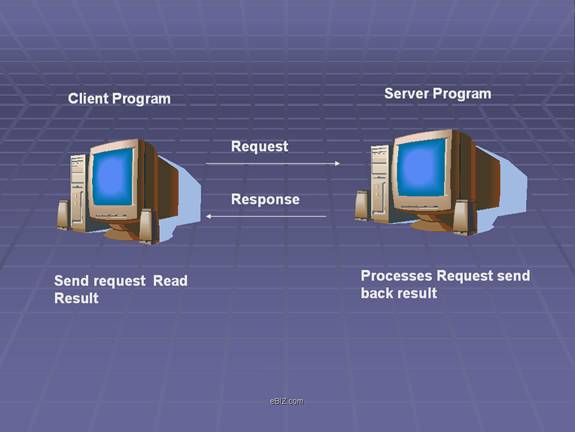
| The following diagram illustrates the relationship between client and server computers. The client requests information; the server processes the request and sends a response back to the client. |
| |
| Most transactions that occur on the Internet are client/server based. Some examples include: |
| |
| • FTP (file transfer protocol) - An FTP client program contacts an FTP server and requests the transfer of a file; the FTP server responds by transferring the file to the client. |
| |
| WWW (World Wide Web) - In this case the client program is a browser. A browser requests the contents of a web page and displays the results on the user's computer. |
| |
| E-MAIL - A mail client program enables the user to interact with a server in order to access, read and send electronic mail messages. |
| |
| The client computer runs an application called a client program. A client program enables a user to send a request for information to the server and read the results that the server sends back. |
| |
| The server computer runs a server program which processes requests and sends results back to the client. Most Internet transactions, such as FTP, e-mail and accessing web pages are based on client/server networking. |
| |
| |
|
| |
| |


