| Introduction to Internet |
| |
| What was ARPANET? |
| |
| ARPANET stands for Advanced Research Projects Agency (ARPA) Network. The network was developed in 1969 by ARPA and funded by the Department of Defense. |
| |
| The network was chiefly experimental, and was used to research, develop and test networking technologies. |
| |
| The original network connected four host computers at four separate universities throughout the United States, enabling users to share resources and information |
| |
| By 1972, there were 37 host computers connected to ARPANET. Also in this year, ARPA's name was changed to DARPA (Defense Advanced Research Projects Agency). |
| |
| In 1973, ARPANET went beyond the boundaries of the United States by making its first international connections to England and Norway. |
| |
| One goal of ARPANET was to devise a network that would still be operational if part of the network failed. The research in this area resulted in a set of networking rules, or protocols, called TCP/IP (Transmission Control Protocol/Internet Protocol). |
| |
| TCP/IP is a set of protocols that govern how data is transmitted across networks. It also enables different types of computer operating systems, such as DOS and UNIX, to share data across a network. |
| |
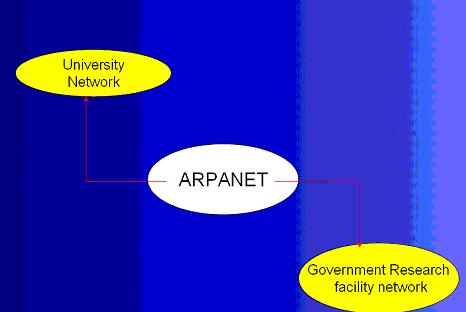
| ARPANET functioned as a "backbone" network - allowing smaller local networks to connect to the backbone. |
| |
| Once these smaller networks were connected to the backbone, they were in effect connected to each other. |
| |
 |
| |
| In 1983, DARPA decided that TCP/IP would be the standard set of protocols used by computers connecting to ARPANET. This meant that any smaller networks (for example, a university network) that wanted to connect to ARPANET also had to be using TCP/IP. |
| |
| TCP/IP was available for free and was increasingly used by networks. The spread of TCP/IP helped create the Internet as we know it today - the network of networks that either use the TCP/IP protocols, or can interact with TCP/IP networks. |
| |
| |
|
| |
| |


