| Introduction to Internet |
| |
| What is the Internet? |
| |
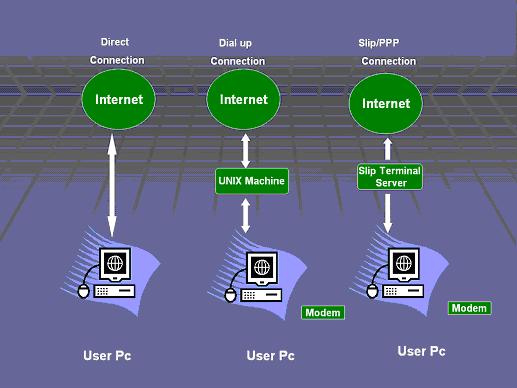
| The Internet links are computer networks all over the world so that users can share resources and communicate with each other. Some computers, have direct access to all the facilities on the Internet such as the universities. And other computers, eg privately-owned ones, have indirect links through a commercial service provider, who offers some or all of the Internet facilities. |
 |
|
| |
| In order to be connected to Internet, you must go through service suppliers. Many options are offered with monthly rates. Depending on the option chosen, access time may vary. |
| |
| The Internet is what we call a metanetwork, that is, a network of networks that spans the globe. It's impossible to give an exact count of the number of networks or users that comprise the Internet, but it is easily in the thousands and millions respectively. |
| |
| The Internet employs a set of standardized protocols which allow for the sharing of resources among different kinds of computers that communicate with each other on the network. |
| |
| These standards, sometimes referred to as the Internet Protocol Suite, are the rules that developers adhere to when creating new functions for the Internet. |
| |
| The Internet is also what we call a distributed system; there is no central archives. Technically, no one runs the Internet. Rather, the Internet is made up of thousands of smaller networks. |
| |
| The Internet thrives and develops as its many users find new ways to create, display and retrieve the information that constitutes the Internet. |
| |
| Internet |
| |
| • A network of networks |
| |
| Based on TCP/IP (Transmission Control Protocol/Internet Protocol) |
| |
| Global |
| |
| A variety of services and tools |
| |
| A network of networks, or "internet," is a group of two or more networks that are: Interconnected physically
capable of communicating and sharing data with each other
able to act together as a single network |
| |
| Machines on one network can communicate with machines on other networks, and send data, files, and other information back and forth. |
| |
| For this to work, the networks and machines that are part of an internet have to agree either to speak the same "language" when they are communicating or to use an "interpreter." |
| |
| This "language" is software that enables the different types of machines on separate networks to communicate and exchange information. |
| |
| To be used by different types of machines yet be understood by all of them, the software must follow a set of rules, or protocol. |
| |
| The Internet, with a capital "I", is the network of networks which either use the TCP/IP protocol or can interact with TCP/IP networks via gateways (the interpreters). |
| |
| The Internet presents these networks as one, seamless network for its users |
| |
| The Internet covers the globe and includes large, international networks as well as many smaller, local-area networks (LANs). |
| |
|
 |
| |
| The Internet offer access to data, graphics, sound, software, text, and people through a variety of services and tools for communication and data exchange: |
| |
| Remote login (telnet) |
| |
| file transfer (ftp) |
| |
| electronic mail (e-mail) |
| |
| news (USENET or network news) |
| |
| hypertext (WWW) |
| |
| |
|
|
| |
| |


