|
| |
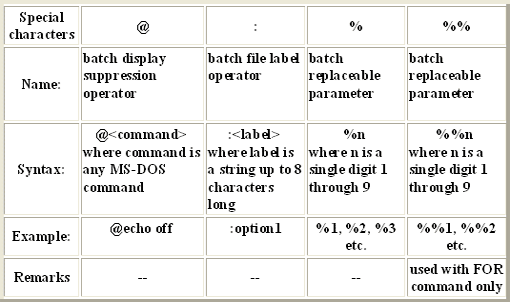
| Batch display-suppression operator |
| o @ can be applied to any command as the first character on
the command line in a batch program. |
| o It's used to prevent an individual command from being displayed when it is executed. |
| |
| |
| Batch file label operator |
| o : is used to identify a location in a batch file.
It is not a command but a prefix of a label. |
| |
| o A label is a companion of the GOTO command. |
i.e. GOTO <label>
:<label> |
| |
| o A label is used to force MS-DOS to move to a
specified location within the batch program. |
| |
| o Normally, when MS-DOS runs a batch program, it
executes commands in the order as they appear in the program.
However, when MS-DOS comes across the GOTO command (e.g. GOTO option1), it
will move to the position that is identified by :option1 within the batch program. |
| |
| |
| Batch replaceable parameter |
| o Consider the following commands frequently used at the DOS prompt:- |
| |
| ? copy autoexec.bat autoexec.bak |
| This command line creates a backup file of the autoexec.bat file. |
| copy is a command, autoexec.bat and autoexec.bak are parameters.
These are required parameters. You must state both of them to make the command work. |
| |
| |
| ? dir /w |
| This command line displays a directory entries of the current directory in wide screen format.
dir is a command, /w is a parameter. It is an optional parameter for qualifying the output of the dir command.
|
| |
| o Similarly, we can make use of parameters to help us
achieve the same capability in executing a batch program.
This way, we can execute the same batch program with different
data at different time. They are called replaceable parameters. |
| |
| o %n and %%n are the special characters which represent the
parameter in a batch program, where n is a single digit, from 1 through 9. |
| |
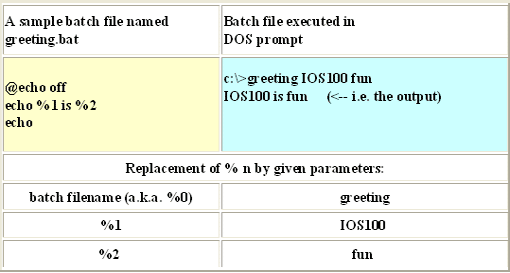
| o The replaceable parameters are positional. The digit, n, of
the special characters represents the position of the parameter we
type with the batch command. |
| |
| For example: |
|