| I/O Operations |
| |
| Insertion & Extraction |
| |
| Insertion is the operation of sending characters to a stream, expressed by the overloaded insertion operator << . Thus, the following statement sends the character 'x' to the stream cout: |
| |
| cout << `x'; |
| |
| Extraction is the operation of taking characters from a stream, expressed by the overloaded extraction operator >>. The following expression (where ch has type char) obtains a single character from the stream cin and stores it in ch. |
| |
| cin >> ch; |
| |
| Although streams produce or consume characters, insertion and extraction can be used with other types of data. |
| |
| For instance, in the following statements, the characters '1' , '2' , and '3' are inserted into the stream cout, after which characters are extracted from cin, interpreted as an integer, and the result is assigned to i: |
| |
| int i = 123; |
| cout << i; |
| cin >> i; |
| |
| Insertion and extraction can be overloaded for user-defined types as well. Consider the following code: |
| |
| class fraction |
| { |
| int numer; |
| unsigned denom; |
| friend ostream& operator <<(ostream& os, fraction& f) |
| { |
| return os << f.numer << `/' << f.denom; |
| }; |
| }; |
| |
| These statements define an insertion operator for a user-defined fraction class, which can be used as conveniently and easily as insertion of characters or ints. |
| |
| Get and put pointers |
| |
| The definition of C++ stream I/O makes use of the concepts of the get pointer and the put pointer. The get pointer for a stream indicates the position in the stream from which characters are extracted. |
| |
| Similarly, the put pointer for a stream indicates the position in the stream where characters are inserted. Use of the insertion or extraction operator on a stream causes the appropriate pointer to move. |
| |
| Note that these are abstract pointers, referencing positions in the abstract sequence of characters associated with the stream, not C++ pointers addressing specific memory locations. |
| |
| You can use member functions of the various stream classes to move the get or put pointer without performing an extraction or insertion. |
| |
| For example, the fstream::seekoff() member function moves the get and put pointers for an fstream. |
| |
| The exact behavior of the get and put pointers for a stream depends on the type of stream. |
| |
| For example, for fstream objects, the get and put pointers are tied together. |
| |
| That is, any operation that moves one always moves the other. For strstream objects, the pointers are independent. That is, either pointer can be moved without affecting the other. |
| |
| The get and put pointers reference positions between the characters of the stream, not the characters themselves. |
| |
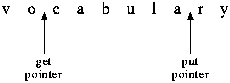
| For example, consider the following sequence of characters as a stream, with the positions of the get and put pointers as marked in Illustration of Get and Put Pointers: |
| |
| Illustration of Get and Put Pointers |
| |
 |
| |
| In this example, the next character extracted from the stream is 'c', and the next character inserted into the stream replaces the 'r'. |
| |
| |
|
| |
| |


