| Programming Techniques |
| |
| Introduction |
| |
| Without a program, a computer has no purpose. It becomes an inert mass, a way to keep a door open when the wind blows. |
| |
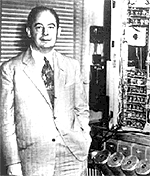
| In 1952, a very clever man named John Von Neumann was working on a rather primitive computer that was programmed by moving wires about on a large plug-board. |
| |
 |
| |
| It occurred to him that the program could be stored within the machine, along with the data, in what we now call “random-access memory.” |
| |
| This research removed the final obstacle to large, complex programs, the ability to switch tasks quickly, and the logical certainly that a program above a certain complexity level cannot be proven to be bug-free. |
| |
| It can fairly be argued that a computer program is a product of pure intellect, has no physical existence, and therefore cannot meaningfully be secured against theft. |
| |
| To summarize, a computer is a machine whose sole purpose is to faithfully carry out a computer program's instructions. |
| |
| It is no more than an input/output device to support the intellectual goals of a computer program (and a programmer). |
| |
| The computer's higher purpose resides in its program. This is why, as time passes, computers become less expensive and programs become more expensive. |
| |
| It is why the richest man in the world is, not a builder of computers, but a builder of programs. |
| |
| It is why, over time, computer scientists have come to focus more on programming issues and less on hardware issues. |
| |
| It is why, when a government agency decides to upgrade its computers, it is almost always the case that, after billions have been spent, they discover the old software will not run on the new hardware, and they abandon the project. |
| |
| |
|
| |
| |

