| To define a class, we use the class keyword and the name of the class: |
| class MyClassName { ... } |
| By default, classes inherit from the Object class. |
| If this class is a subclass of another specific class (that is, inherits from another class), use extends to indicate the superclass of this class: |
| class myClassName extends mySuperClassName { ... } |
| Following is the code for a class called SimplePoint that represents a point in 2D space: |
| public class SimplePoint { public int x = 0; public int y = 0; } |
| This segment of code declares a class-- a new data type really-- called SimplePoint. The SimplePoint class contains two integer member variables, x and y. The public keyword preceding the declaration for x and y means that any other class can freely access these two members. |
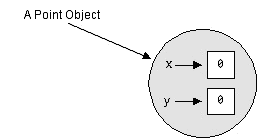
| We create an object from a class such as SimplePoint by instantiating the class. When we create a new SimplePoint object space is allocated for the object and its members x and y. In addition, the x and y members inside the object are initialized to 0 because of the assignment statements in the declarations of these two members. |
 |
| Ex: |
| public class SimpleRectangle { public int width = 0; public int height = 0; public SimplePoint origin = new SimplePoint(); } |
| Here the segment of code declares a class SimpleRectangle-- that contains two integer members, width and height. |
| SimpleRectangle also contains a third member, origin, whose data type is SimplePoint. |
| Here the class name SimplePoint is used in a variable declaration as the variable's type. We can use the name of a class anywhere we can use the name of a primitive type. |
| As with SimplePoint, when we create a new SimpleRectangle object, space is allocated for the object and its members, and the members are initialized according to their declarations. |
| The initialization for the origin member creates a SimplePoint object with this code: new SimplePoint() as illustrated here: |
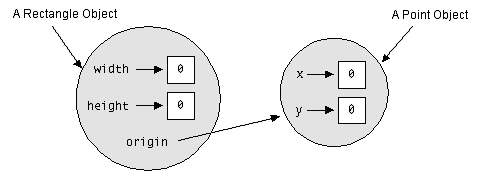 |
| This diagram shows the difference between primitive types and reference types |
   |