| . Is part of the java.io package |
| . Is an extension of the OutputStream class, an abstract class that describes the behavior of an output stream |
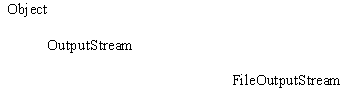 |
| . Is a low-level class that can be used to send individual, 8-bit bytes to a stream |
| . Has several constructors. The most frequently used constructs a FileOutputStream object from a File object that encapsulates the file's pathname. For example, if fd is the reference of a File object |
| FileOutputStream out = new FileOutputStream(fd); |
| It will construct a FileOutputStream object for sending bytes to the file. If the file already exists, its contents will be replaced (there is an overloaded constructor to specify appending). Because a checked, IOException may occur, the statement should be enclosed in a try block with an appropriate catch. |
| . Has a few useful methods. The two most used are: |
 |
| Because a checked, IOException may occur, calls to these methods should be enclosed in a try block with an appropriate catch. Consult the Java API documentation for more details. |
| . Example. The following program can be used to create a file of numbers on disk. |
| // Open an output stream for the file. |
| out = new FileOutputStream(fd); |
| // This loop asks the user to enter a import |
| java.io.*; public class AppFOS { public static void main(String[] args) { // Local variables and object references. char again = 'y'; File fd; FileOutputStream out; // Get the path name from the user. System.out.print("Enter the file's complete path name: "); fd = new File(Keyboard.readString()); // Try to write data to the output stream. try { //number and writes it to the // stream. The user is then asked if they want to enter another. while (again == 'Y' || again == 'y') { System.out.print("Enter a number: "); int theNumber = Keyboard.readInt(); out.write(theNumber); System.out.print("Again? (Y/N): "); again = Keyboard.readChar(); } // Close the stream. out.close(); System.out.println("Closed - " + fd.getPath()); } // Catch an IOException if one is thrown. catch (IOException e) { System.out.println(e.getMessage()); } } } |
 |
 |
 |