 |
 |
 |
| Array and String | |||
| Introduction of Array | |||
| Whenever there is need to store a group of data of the same type in the memory, arrays are used. Two terms has been described here Array and String. | |||
| Strings in C are represented by the array only therefore it would be convenient to describe strings separately in the same block but in the different section. | |||
| Arrays are the contiguous memory location used to store similar data type or in other terms we can say Arrays are a data structure which holds multiple variables of the same data type. | |||
| Consider the case where a programmer needs to keep track of a number of people within an organization. So far, our initial attempt will be to create a specific variable for each user. | |||
| This might look like: | |||
| int name1 = 101; | |||
| int name2 = 232; | |||
| int name3 = 231; | |||
| It becomes increasingly more difficult to keep track of this as the number of variables increases. Arrays offer a solution to this problem. | |||
| An array is a multi-element box, a bit like a filing cabinet, and uses an indexing system to find each variable stored within it. | |||
| In C, indexing starts at zero. Arrays, like other variables in C, must be declared before they can be used. | |||
| The replacement of the above example using arrays looks like: | |||
| int names[4]; | |||
| names[0] = 101; | |||
| names[1] = 232; | |||
| names[2] = 231; | |||
| names[3] = 0; | |||
| We created an array called names, which has space for four integer variables. You may also see that we stored 0 in the last space of the array. | |||
| This is a common technique used by C programmers to signify the end of an array. | |||
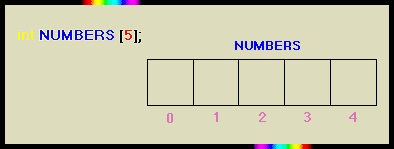
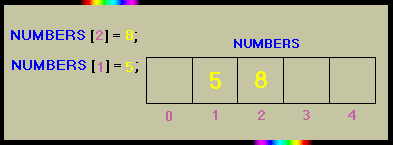
| An image showing internal stucture and location distribution method of array > | |||
|
|||
|
|||
|
|||