| Expressions |
| |
| Automatic type conversion |
| |
| If the operands are of different types the lower type is automatically converted to the higher type before the operation proceeds |
| The result is of the higher type |
| |
| Given below is the sequence of rules that are applied by evaluating expressions. |
| |
| Operator 1 |
Operator 2 |
Result |
| Long Double |
any |
Long Double |
| Double |
any |
Double |
| Float |
any |
Float |
| Unsigned Long Int |
any |
Unsigned Long In |
| Long Int |
any |
Long Int |
| Unsigned Int |
any |
Unsigned Int |
|
| |
| Final result of an expression to the type of the variable on the left of the assignment signed before assigning the value to it. |
| |
| However, the following changes are introduced during the final assignment: |
| |
| 1. Float to Int causes truncation of the fractional part. |
| |
| 2. Double to float causes rounding of digits. |
| |
| 3. Long int to int causes dropping of the excess higher order bits |
| |
| Type Casting: |
| |
| Casting a value is a forcing a type conversion in a way that is different from the automatic conversion and this process is called type cast. |
| This should be clear from the following examples: |
| |
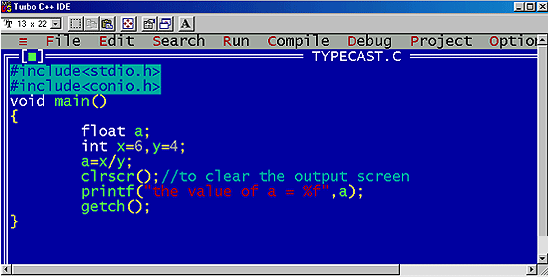
| An example of automatic conversion: |
| |
 |
| |
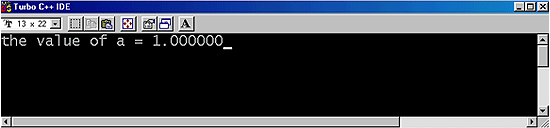
| Output of automatic conversion: |
| |
 |
| |
| The answer turns out to be 1.000000 and not 1.5 this is because, 6 and 4 are both integers, and hence 6/4 yields an integer, 1. |
| |
| This 1 when stored in a is converted to 1.000000. But what if you don't want the question to be truncated. One solution is to make either x or y as a float. |
| |
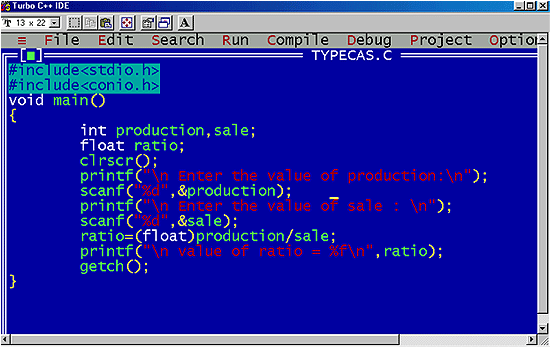
| The general form of casting is: |
| |
| (type_desired) expression; |
| where type_desired : standard C data types and |
| expression: constant, variables or an expression. |
| |
| An example of type casting: |
| |
 |
| |
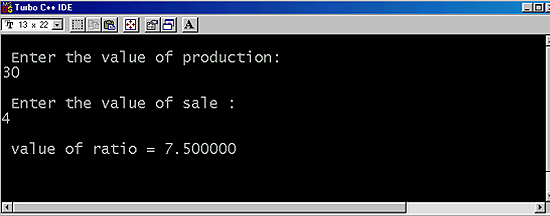
| Output of type casting example: |
| |
 |
| |
| Type Definition using typedef |
| |
| C allows us to create data types via the typedef statement. |
| |
| The format of typedef statement is: |
| |
| typedef data type new_type_name; |
| |
| Example: |
| |
| typedef int units; |
| units bat1,bat2; /*this statement is equivalent to int bat1,bat2*/ |
| |
| |
| |
| |
| |


