2. Copy the code written below or write it .
<script runat="server">
void Application_Start(object sender, EventArgs e)
{
// An Application variable to maintain the state at application level.
Application["appstate"] = "Application String";
// Code that runs on application startup.
}
void Application_End(object sender, EventArgs e)
{
// Code that runs on application shutdown
}
void Application_Error(object sender, EventArgs e)
{
// Code that runs when an unhandled error occurs
}
void Session_Start(object sender, EventArgs e)
{
// An Session variable to maintain the state at session level.
Session["mysession"] = "Session String";
// Code that runs when a new session is started
}
void Session_End(object sender, EventArgs e)
{
// Code that runs when a session ends.
}
</script>
using System.Data; using System;
using System.Data;
using System.Configuration;
using System.Web;
using System.Web.Security;
using System.Web.UI;
using System.Web.UI.WebControls;
using System.Web.UI.WebControls.WebParts;
using System.Web.UI.HtmlControls;
public partial class _Default : System.Web.UI.Page
{
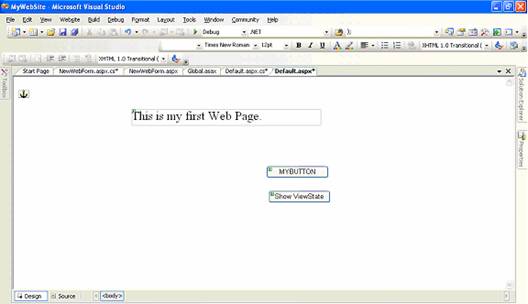
protected void Page_Load(Object sender, EventArgs e)
{
// The ViewState variable to maintain the state at Page level.
ViewState["myviewstate"] = "ViewState String";
//To write the text to web page.
Response.Write( "This is Session Value: " +
Session["mysession"].ToString() + "<br>
");
}
protected void mybutton_Click(object sender, EventArgs e)
{
//To move to different web page or url.
Response.Redirect("NewWebForm.aspx?Name=ebiz&Open=yes");
}
protected void Button1_Click(object sender, EventArgs e)
{
Response.Write("This is ViewState Value: " + ViewState["myviewstate"].ToString());
}
}
using System.Configuration;
using System.Web;
using System.Web.Security;
using System.Web.UI;
using System.Web.UI.WebControls;
using System.Web.UI.WebControls.WebParts;
using System.Web.UI.HtmlControls;
public partial class _Default : System.Web.UI.Page
{
protected void Page_Load(Object sender, EventArgs e)
{
// The ViewState variable to maintain the state at Page level.
ViewState["myviewstate"] = "ViewState String";
//To write the text to web page.
Response.Write( "This is Session Value: " + Session["mysession"].ToString() + "<br>
");
}
protected void mybutton_Click(object sender, EventArgs e)
{
//To move to different web page or url.
Response.Redirect("NewWebForm.aspx?Name=ebiz&Open=yes");
}
protected void Button1_Click(object sender, EventArgs e)
{
Response.Write("This is ViewState Value: " + ViewState["myviewstate"].ToString());
}
}
using System.Data;
using System.Configuration;
using System.Collections;
using System.Web;
using System.Web.Security;
using System.Web.UI;
using System.Web.UI.WebControls;
using System.Web.UI.WebControls.WebParts; using System.Web.UI.HtmlControls;
public partial class NewWebForm : System.Web.UI.Page
{
protected void Page_Load(object sender, EventArgs e)
{
string name;
//To get value of Query String which was passed in default.aspx page.
name = "Name:" + Request.QueryString["Name"].ToString();
Response.Write(name + "<br>
<br>");
//To get value of Session Variable which was assigned in default.aspx page.
Response.Write( "This is Session Value: " + Session["mysession"].ToString());
//To get value of ViewState Variable which was assigned in default.aspx page.
 |
 |
 |